
Conquer Countries
Conquer Countries, a mobile strategy game by Supersonic Studios LTD, places players in the role of a president tasked with leading a nation to global dominance. Released in 2024, this role-playing game blends strategic decision-making, diplomacy, and resource management into an accessible yet engaging experience. Available on Android, iOS, and PC via emulators like BlueStacks, Conquer Countries has captivated players with its intuitive mechanics and dynamic scenarios. This article explores the game’s origins, gameplay, appeal, challenges, and cultural impact, revealing why it stands out in the crowded world of mobile strategy games.

Origins and Development
Conquer Countries emerged as part of the mobile gaming boom, capitalizing on the popularity of simulation games that let players manage virtual societies. Developed by Supersonic Studios LTD, known for titles like Join Clash 3D, the game draws inspiration from grand strategy titles like Civilization VI but simplifies the experience for casual players. Launched on the App Store and Google Play in 2024, it quickly gained traction for its fast-paced, turn-based gameplay. Updates, such as new maps (Neptune, Pluto) and space-themed challenges, have kept the game fresh, with developers actively addressing player feedback on issues like bugs and ad frequency.
The game’s premise—leading a nation through diplomatic and military decisions—taps into the universal appeal of power fantasy. Its lighthearted tone, occasionally peppered with quirky humor about aliens or futuristic scenarios, distinguishes it from more serious strategy games, though some players find this humor jarring. Despite its simplicity, Conquer Countries offers enough depth to challenge players while remaining approachable for newcomers.
Gameplay Mechanics
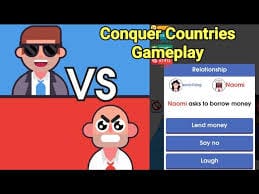
In Conquer Countries, players assume the role of a president, choosing a starting nation and making decisions that shape its fate. The core objective is to expand territory, strengthen the economy, and maintain citizen happiness through strategic choices. Each turn, players face scenarios—economic crises, political unrest, or opportunities like investing in AI or renewable energy—that require selecting one of multiple options. These choices impact resources like money, population, intelligence, military strength, and happiness, with consequences unfolding over time.
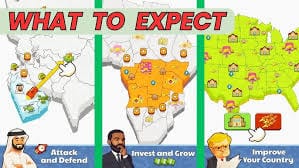
The gameplay is turn-based, with decisions appearing every few seconds, keeping the pace brisk. Players can expand through diplomacy, forming alliances with AI-controlled nations or other players, or through military conquest, battling to seize territories. Resource management is critical: over-investing in defense may upset citizens, while printing too much money risks inflation. Diplomacy adds depth, as alliances can bolster your position but risk betrayal. Battles are determined by population differences, with a luck factor that some players find frustrating, as even a 60% victory chance can lead to unexpected losses.
The game includes unique features like space exploration challenges, where players tackle interplanetary scenarios, and a capital development system for building infrastructure. Macros and multi-instance sync on PC emulators like BlueStacks or LDPlayer enhance efficiency, allowing players to automate tasks or manage multiple accounts for faster progression. The interface is simple, relying on taps and selections, making it ideal for mobile play, though PC versions offer smoother graphics and controls.
Why It Captivates
Conquer Countries strikes a balance between accessibility and strategy, appealing to both casual gamers and strategy enthusiasts. Its turn-based gameplay is easy to pick up, requiring no complex controls, yet the cascading effects of decisions demand foresight. The game’s replayability comes from its varied scenarios—each playthrough feels unique due to randomized events and player choices. Whether you prioritize a strong economy or aggressive expansion, the game adapts to your style, offering flexibility.
The power fantasy of leading a nation resonates widely, letting players feel like global leaders without the steep learning curve of titles like Hearts of Iron IV. The inclusion of space-themed content, such as managing lunar bases, adds a novel twist, though some find it thematically inconsistent. The game’s vibrant visuals and straightforward interface enhance its appeal, particularly on mobile devices, where it runs smoothly even on older hardware.
Social elements, like forming alliances or competing on leaderboards, foster a sense of community. Players share strategies on platforms like Reddit, discussing optimal resource allocation or diplomatic tactics. However, the game’s reliance on ads—often every 1–2 minutes—has drawn criticism for disrupting the flow, with some players reporting glitches in ad rewards or excessive phone heating. Despite these issues, the option to watch ads for bonuses, rather than mandatory interruptions, gives players some control, and the developers have acknowledged feedback for future improvements.
Educational and Cognitive Benefits
Conquer Countries offers subtle educational value, particularly in decision-making and critical thinking. Players learn to weigh trade-offs, such as balancing military spending against citizen happiness, fostering an understanding of resource allocation. The game introduces basic economic concepts like inflation and diplomacy’s role in geopolitics, making it a light introduction to political strategy. For younger players, it encourages logical reasoning and consequence analysis, as each choice visibly impacts the nation’s trajectory.
In classrooms, Conquer Countries could be used to spark discussions about governance or international relations, though its simplified mechanics limit historical accuracy. Parents appreciate its ability to engage kids in strategic thinking without violence-heavy themes, though adult supervision may be needed to contextualize abstract scenarios like space colonization.
Cultural Impact and Challenges
Conquer Countries has carved a niche in mobile gaming, with a growing community on platforms like Google Play and the App Store. Reviews praise its addictive nature and strategic depth, comparing it to a streamlined Civilization VI. However, player feedback highlights issues: frequent ads, occasional bugs (e.g., moon level freezes), and inconsistent battle outcomes frustrate some users. The developers have responded, fixing issues like capital scene crashes and promising further enhancements.
The game’s quirky humor, including references to aliens, divides players—some enjoy the whimsy, while others find it out of place in a strategy game. Despite these critiques, its accessibility and free-to-play model ensure broad appeal, with PC emulation expanding its reach to players seeking a larger-screen experience.
Conclusion
Conquer Countries is a compelling blend of strategy, diplomacy, and resource management, offering a streamlined yet engaging take on nation-building. Its accessible mechanics, varied scenarios, and replayability make it a standout for casual gamers, while its depth satisfies strategy fans. Though marred by ad frequency and minor bugs, ongoing updates signal a commitment to improvement. Whether forging alliances or conquering rivals, Conquer Countries invites players to shape a nation’s destiny, one decision at a time, proving that even simple choices can lead to global greatness.